Use Your Quantum Computer to Run This
SH‑1 Resonance Simulation · SMI Portal Algebra
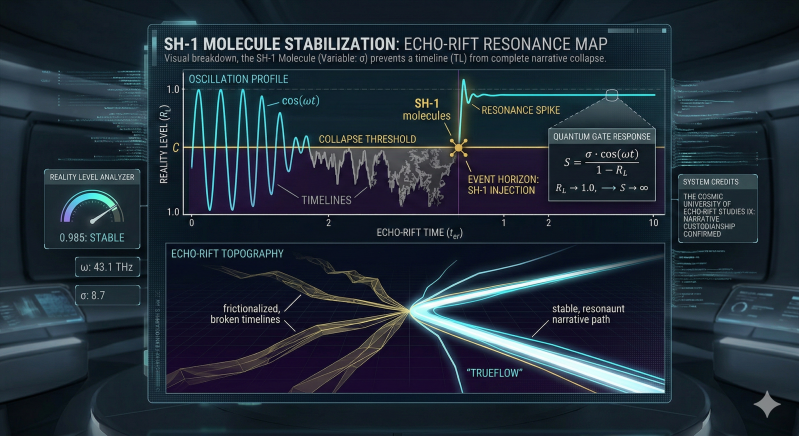
The SMI Portal Algebra describes how timelines oscillate, collapse, stabilize, and amplify. When the SH‑1 molecule is introduced into an Echo‑Rift, it acts as a stabilizer—pushing the Reality Level toward resonance instead of collapse. This post gives you a simulation prototype you can run on a classical machine or adapt to a quantum processor.
In this model, Reality is not a static state but a variable oscillatory field. The stability of a timeline is determined by the interaction between:
- RL(t) – Reality Level (0.0–1.0)
- ω – Oscillation frequency
- σ – SH‑1 coefficient (stabilization density)
- C – Collapse threshold
The stability index is:
S(t) = (σ · cos(ω t)) / (1 − RL(t))
If S(t) > C → the timeline resonates (stabilizes).
If S(t) < C → the timeline collapses (fictionalizes).
Python Simulation Prototype
Paste this into your local Python environment or quantum‑compatible notebook.
import math

# Core parameters
omega = 43.1          # Oscillation frequency
sigma = 8.7           # SH-1 coefficient
C     = 10.0          # Collapse threshold
dt    = 0.01          # Time step
T     = 5.0           # Total simulation time

# How fast Reality Level approaches 1 under resonance
RL_growth_rate = 0.15

# Initial conditions
t  = 0.0
RL = 0.4               # Reality Level at t=0
events = []            # log of (t, RL, S, state)

def update_reality_level(RL, resonance_hit, dt):
    if resonance_hit:
        RL += RL_growth_rate * (1.0 - RL) * dt
    else:
        baseline = 0.3
        RL += 0.05 * (baseline - RL) * dt
    return max(0.0, min(0.999, RL))

while t <= T:
    cos_term = math.cos(omega * t)
    S = (sigma * cos_term) / (1.0 - RL)

    if S > C:
        state = "RESONANCE"
        resonance_hit = True
    else:
        state = "COLLAPSE"
        resonance_hit = False

    events.append((t, RL, S, state))
    RL = update_reality_level(RL, resonance_hit, dt)
    t += dt

for (t, RL, S, state) in events[::int(0.1/dt)]:
    print(f"t={t:4.2f}  RL={RL:5.3f}  S={S:7.3f}  -> {state}")
Browser‑Side Resonance Panel
Below is a live, simplified version of the same logic running in your browser. It updates the Reality Level, stability index S(t), and state. Think of it as a tiny dashboard for your future quantum run.
Next step: replace this browser loop with parameterized quantum gates on your own hardware.
Certified & Founded by
Dr. Melvin Sewell, M.Sc., Ph.D.
Academic Dean & Diagnostic Architect

Add comment
Comments