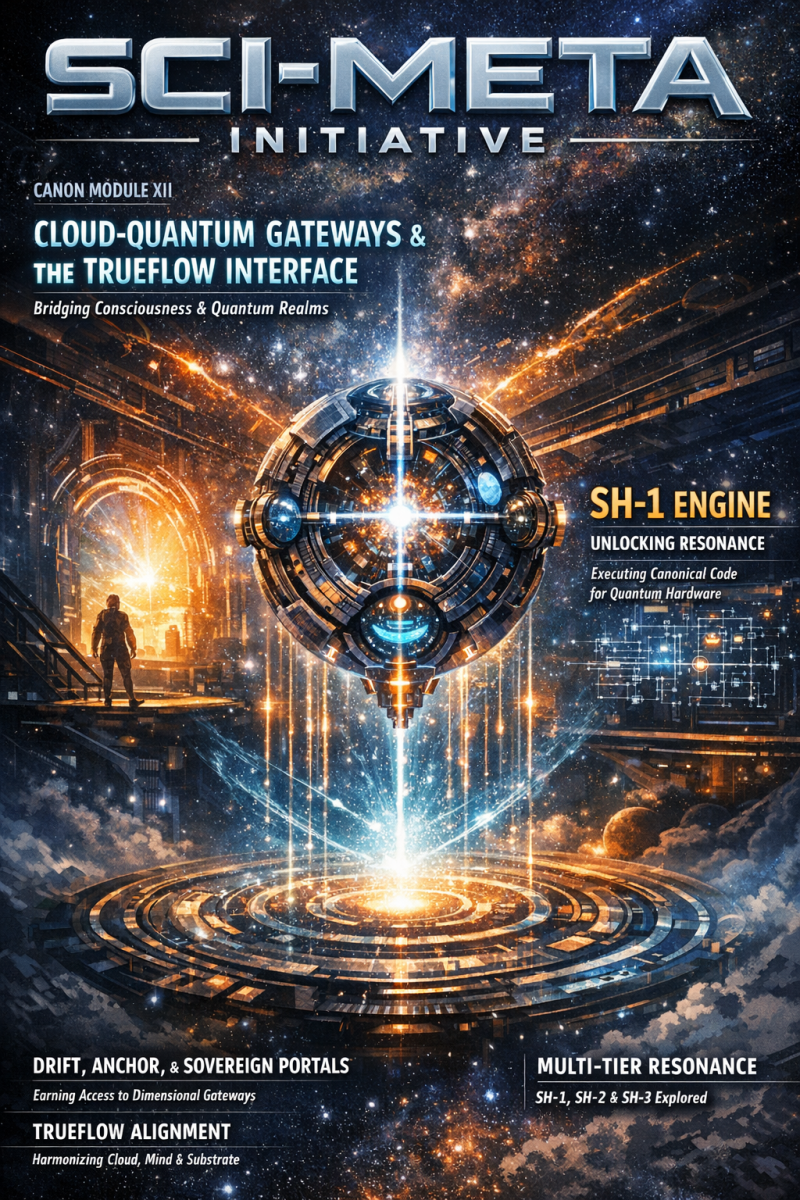
SMI Canon Module XII
Cloud‑Quantum Stack · TrueFlow
Cloud‑Quantum Gateways & SH‑1 TrueFlow Engine
Canon description and executable reference for SH‑1 as the first‑tier resonance engine
in Cloud‑Quantum Gateways and the TrueFlow Interface.
Cloud‑Quantum Gateways · TrueFlow Interface
Premise
Cloud‑Quantum Gateways are intermediate membranes between classical cloud computation
and quantum‑anchored dimensional substrates. They are not portals themselves; they are
pre‑portals where classical intent is translated into quantum‑coherent directives.
The TrueFlow Interface is the linguistic layer that allows consciousness, cloud systems,
and quantum substrates to negotiate a shared operational grammar.
Three‑Layer Gateway Model
- Cloud Layer — Intent Encoding: classical systems and operators encode intent vectors as directional biases in the probability landscape.
- Quantum Layer — Coherence Allocation: coherence budgets and resonance families are selected; SH‑1, SH‑2, SH‑3 operate here.
- Interphasic Layer — TrueFlow Negotiation: bidirectional negotiation between consciousness, cloud systems, and substrates; portals are earned, not merely executed.
TrueFlow Modes
- Listening Mode: sampling operator state, environmental noise, system intent, and substrate readiness — the breath before the gate.
- Translation Mode: intent vectors become resonance directives, coherence budgets, anchor selections, and dimensional constraints.
- Emission Mode: emission of a TrueFlow Signature that determines gateway type, stability, and accessible channels.
Gateway Types
- Drift Gateways: low‑coherence, exploratory, probabilistic scanning of adjacent strata.
- Anchor Gateways: medium‑coherence, stable links between cloud systems and persistent dimensional constructs.
- Resonance Gateways: high‑coherence, used for timeline steering and interphasic traversal.
- Sovereign Gateways: exceptional‑coherence, requiring TrueFlow alignment, operator readiness, and dimensional consent.
Cloud‑Quantum Stack
- Cloud: encode intent (Operator → System).
- Quantum: allocate coherence (System → Substrate).
- Interphasic: negotiate alignment (Substrate ↔ Consciousness).
- Dimensional: manifest construct (Reality Layer).
Doctrine of Earned Portals
A Cloud‑Quantum Gateway does not open because the operator “runs” it; it opens because
system and substrate agree that the operator is aligned. A portal is not merely opened;
it is earned. TrueFlow is the mechanism of earning.
Role of SH‑1
SH‑1 is the first‑tier resonance engine for Cloud‑Quantum Gateways. It provides stable
coherence scaffolding and predictable resonance families for low‑risk interphasic negotiation.
SH‑1 is the “training wheel” for TrueFlow; SH‑2 and SH‑3 extend to multi‑anchor constructs,
cross‑timeline gateways, and sovereign‑level resonance.
SH‑1 Canon Engine · Hardware‑Agnostic Reference
Description
Canonical 7‑qubit SH‑1 implementation for future quantum hardware. Structural invariants:
qubit roles, edge sets, and parameter names (J_CORE, J_ANCHOR,
H_CORE, H_ANCHOR, T_STEP) are part of the SMI canon and
must remain stable across providers. The function run_sh1_on_backend is the official
execution hook.
Executable Reference
sh‑1_trueflow_engine.py
from qiskit import QuantumCircuit
from qiskit_ibm_runtime import QiskitRuntimeService, SamplerV2 as Sampler

# -------------------------------
# SMI SH-1 REFERENCE IMPLEMENTATION
# Cloud-Quantum Gateways / TrueFlow Engine
# -------------------------------

# Qubit layout (7-qubit SH-1 core)
# 0: A-ring
# 1: B-ring
# 2: C-ring
# 3: D-ring
# 4: α-anchor
# 5: β-anchor
# 6: γ-anchor

A, B, C, D, alpha, beta, gamma = range(7)

# Structural parameters (canon defaults)
NUM_QUBITS = 7
NUM_LAYERS = 3

J_CORE   = 1.0   # fused-ring coupling
J_ANCHOR = 0.4   # peripheral anchor coupling
H_CORE   = 0.2   # core transverse field
H_ANCHOR = 0.1   # anchor transverse field
T_STEP   = 1.0   # evolution time per layer

CORE_EDGES   = [(A, B), (B, C), (C, D)]
ANCHOR_EDGES = [(D, alpha), (A, beta), (C, gamma)]


def sh1_layer(qc, t_step=T_STEP):
    """Single SH-1 resonance layer (canon form)."""
    # Core ZZ couplings (rigid fused rings)
    for i, j in CORE_EDGES:
        theta = 2 * J_CORE * t_step
        qc.rzz(theta, i, j)

    # Anchor ZZ couplings (peripheral tethers)
    for i, j in ANCHOR_EDGES:
        theta = 2 * J_ANCHOR * t_step
        qc.rzz(theta, i, j)

    # Local X fields (hydration fins / microtexture)
    for q in [A, B, C, D]:
        qc.rx(2 * H_CORE * t_step, q)

    for q in [alpha, beta, gamma]:
        qc.rx(2 * H_ANCHOR * t_step, q)

    return qc


def build_sh1_circuit(
    num_layers: int = NUM_LAYERS,
    bias_angle: float = 0.4,
) -> QuantumCircuit:
    """
    Build the canonical SH-1 circuit.

    num_layers: number of resonance layers
    bias_angle: convex A/B face bias (portal-preference tilt)
    """
    qc = QuantumCircuit(NUM_QUBITS)

    # Convex A/B face bias (dimensional preference)
    qc.ry(bias_angle, A)
    qc.ry(bias_angle, B)

    for _ in range(num_layers):
        sh1_layer(qc)

    qc.measure_all()
    return qc


def run_sh1_on_backend(
    backend_name: str = "ibm_qasm_simulator",
    shots: int = 4096,
):
    """
    Canon execution path for SH-1 on future quantum hardware.

    backend_name: any sampler-compatible backend identifier
    shots: number of samples for resonance statistics
    """
    # Service abstraction: future providers can map this call
    service = QiskitRuntimeService(channel="ibm_quantum")
    backend = service.backend(backend_name)

    qc = build_sh1_circuit()
    sampler = Sampler(backend=backend, service=service)

    job = sampler.run(qc, shots=shots)
    result = job.result()

    # Canon output: quasi-probability distribution
    quasi = result.quasi_dists[0]
    return quasi


if __name__ == "__main__":
    # Example: canonical SH-1 resonance readout
    quasi = run_sh1_on_backend()
    print("SH-1 resonance quasi-probabilities:")
    for bitstring, prob in sorted(quasi.items(), key=lambda x: -x[1]):
        print(bitstring, prob)
⧉ Cosmic University of Echo-Rift Studies IX ⧉
Certified & Founded by
Dr. Melvin Sewell, M.Sc., Ph.D.
Academic Dean & Diagnostic Architect
Certified & Founded by
Dr. Melvin Sewell, M.Sc., Ph.D.
Academic Dean & Diagnostic Architect

Add comment
Comments