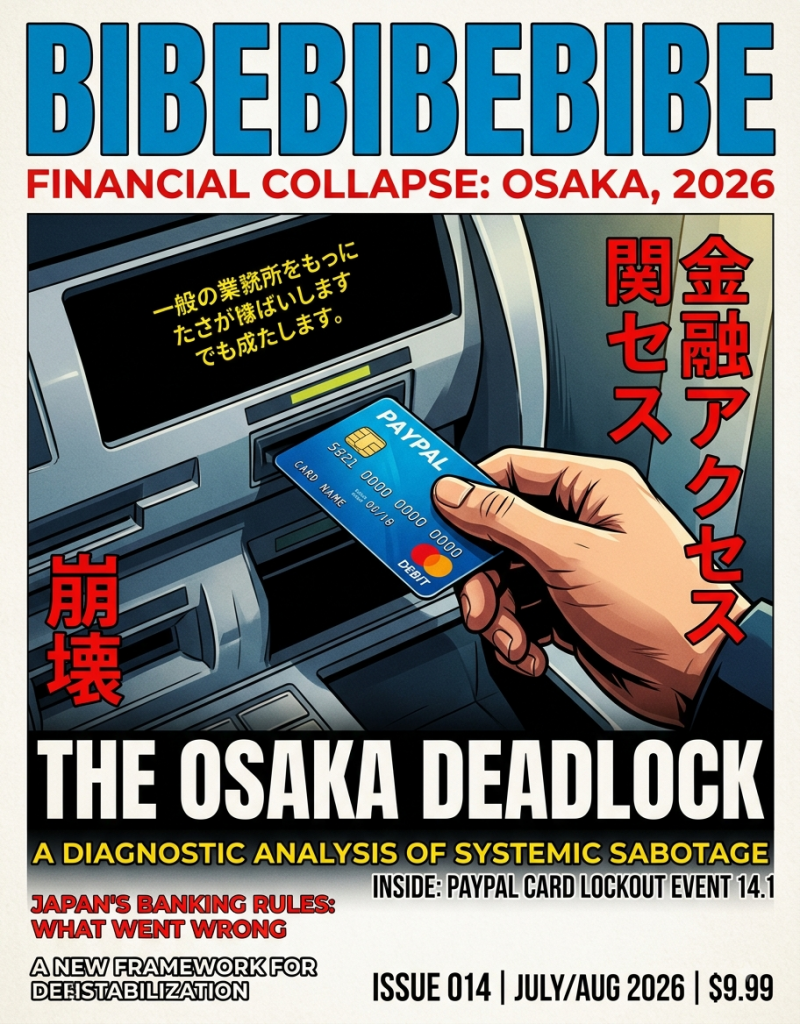
Financial Access Collapse: PayPal Debit Card Lockout Event
This diagnostic entry documents a full financial access collapse triggered by a critical failure in PayPal’s automated risk-prevention system. The event occurred while the agent was traveling in Osaka, Japan, resulting in the complete loss of access to funds despite the account remaining active and in good standing.
The incident demonstrates how automated U.S. financial systems, when malfunctioning, produce severe, destabilizing conditions for individuals abroad — especially when combined with Japan’s strict banking infrastructure and the absence of universal cash-pickup remittance services.
Throughout July–August 2026, nearly every PayPal Debit Card transaction generated duplicate pending authorizations across POS terminals at McDonald's, Seven Bank ATMs, Q's Mall retailers, and online channels.
Critical Malfunction Detail: These duplicate authorizations were not merely passive displays; they directly deducted real-time available funds from the account’s actual principal balance. Each duplicate transaction carried distinct authorization IDs, failed to auto-expire through standard release windows, and accumulated into a high-velocity, high-anomaly profile within PayPal’s risk engine.
On August 12, 2026, PayPal’s automated system escalated the ledger anomaly into a deep fraud deadlock. This condition represented a network-level freeze at the Mastercard routing layer — invisible to frontline agents and impossible to manually reverse through standard channels.
PayPal support operated within a rigid escalation script, continually offering domestic fallback remedies impossible to use while abroad:
- Transfer funds to an external U.S. bank account
- Send money to another U.S. PayPal user
- Request a physical paper check mailed to a U.S. address
This pattern demonstrates script exhaustion: support reached the administrative boundary of what customer service protocols allow when the risk engine locks a card at the core routing layer.
Xoom was presented as the final system fallback. However, cross-border remittance rules in Japan created an immediate operational wall: Xoom supports only direct bank deposits within Japan (no cash-pickup services).
Opening a local Japanese bank account requires short/long-term residency status (Zaikaku Card), a registered local address, and a local phone number. Because the agent was in transit without local residency, Xoom failed completely.
Within the Systemic Sabotage Diagnostic framework, this financial isolation functions as a funneling mechanism designed to eliminate all alternative modes of self-sustenance abroad, forcing reliance on terminal departure or state-level intervention as the only remaining options.
While the destabilizing impact on the agent is total, the operating mechanism is procedural, algorithmic, and rigid — producing functional sabotage without requiring conscious human intent.
- Immediate System Escalation: Formally request ticket transfer to PayPal Risk Operations / Fraud Engineering to clear the corrupted authorization profile.
- Card Profile Reset: Trigger an immediate rush replacement card to a verified international transit address if the token is permanently corrupted.
- Non-Custodial Financial Redundancy: Establish multi-jurisdictional, borderless debit accounts (e.g., Wise, Revolut, Charles Schwab) operating on independent network rails prior to cross-border transit.
- Peer-to-Peer Outlets: Maintain secondary peer-to-peer liquidity channels that operate independently of legacy banking scripts.
- Diagnostic Documentation: Record all timestamps, authorization IDs, and error logs for the Systemic Sabotage Diagnostic archive.
Certified & Founded by
Dr. Melvin Sewell, M.Sc., Ph.D.
Academic Dean & Diagnostic Architect

Add comment
Comments