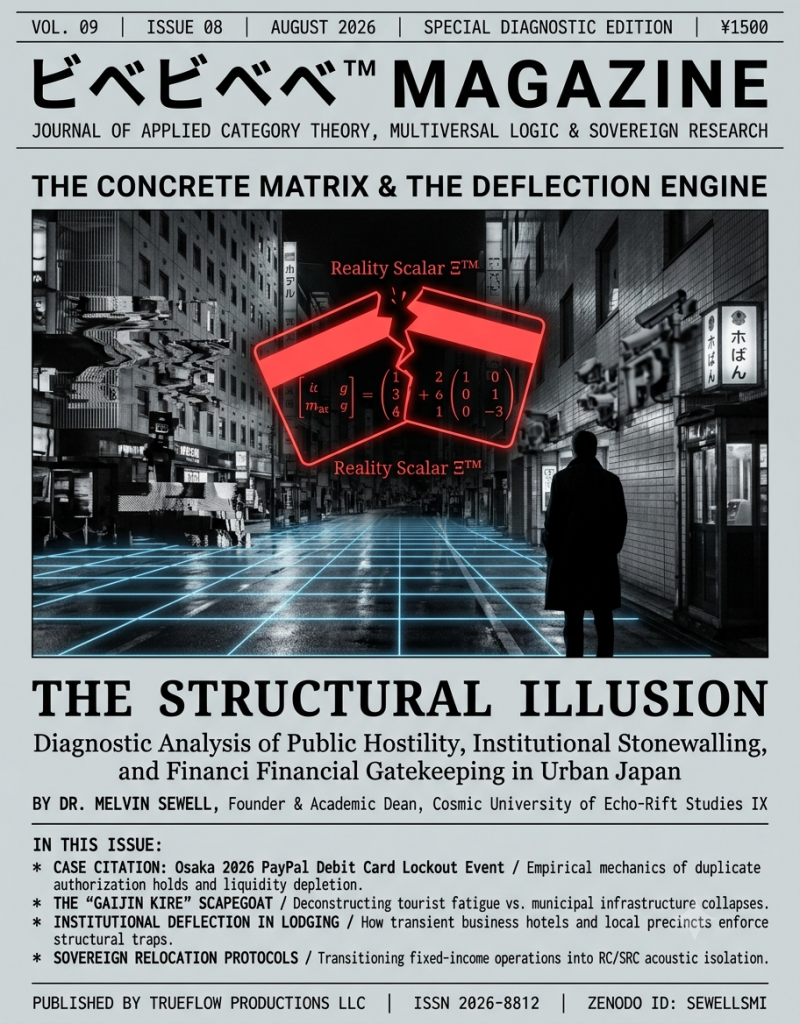
THE STRUCTURAL ILLUSION: DIAGNOSTIC ANALYSIS OF PUBLIC HOSTILITY, INSTITUTIONAL STONEWALLING, AND FINANCIAL GATEKEEPING IN URBAN JAPAN
EXECUTIVE SUMMARY
The global positioning of urban Japan as a hyper-efficient, frictionless, and universally hospitable environment (omotenashi) collapses when non-conforming, independent foreign operators encounter edge-case operational failures. This paper presents a live diagnostic analysis of the structural friction points that emerge when an independent creator, theoretical researcher, or digital publisher moves through high-density Japanese urban centers outside traditional corporate or tourist pipelines.
Through empirical field observations in Osaka, this diagnostic establishes that public hostility, hotel management failures, police non-intervention, and card processing lockouts are not isolated personal misfortunes. Rather, they are predictable systemic outputs engineered by rigid social hierarchies, institutional deflection, and automated de-risking protocols.
SECTION 1: THE MYTH OF OMNIPRESENT HOSPITALITY VS. SPATIAL PROFILING
The global branding of urban Japan as a friction-free, hyper-polite sanctuary relies on a carefully manufactured myth: omotenashi, the ideology of selfless, non-intrusive hospitality. For short-term tourists moving through predictable, high-volume consumer corridors, this curated façade remains intact. However, the moment an independent, non-conforming foreign national steps outside the passive consumer role, the public environment shifts from superficial courtesy to active surveillance, micro-policing, and explicit spatial hostility.
+-----------------------------------------------------------------------------------+
|                        SPATIAL PROFILING & PUBLIC HOSTILITY                       |
+-----------------------------------------------------------------------------------+
|  1. Visual Non-Conformity & Physical Presence                                     |
|     -> Athletic, tall, or independent foreign presence disrupts group uniformity. |
|                                                                                   |
|  2. Hyper-Surveillance & Micro-Policing                                           |
|     -> Private security & elderly residents enforce informal spatial borders.   |
|                                                                                   |
|  3. Overt Verbal & Behavioral Aggression                                         |
|     -> Unprovoked insults ("minikui kao"), intrusive staring, personal space breach. |
|                                                                                   |
|  4. Institutional Defense & "Gaijin Kire"                                         |
|     -> Systemic urban fatigue is misdirected at independent, non-corporate targets|
+-----------------------------------------------------------------------------------+
1. Micro-Aggressions and Verbal Hostility in Public Spaces
In urban hubs like Osaka, public space is strictly governed by unspoken rules of visual homogeneity and behavioral compliance. Foreign professionals—particularly those who exhibit physical stature, athletic builds, or independent movement—are immediately flagged as disruptive elements to the social fabric.
This friction manifests not merely as passive curiosity, but as direct behavioral hostility. Incidents range from relentless, intrusive staring by older generations to unprovoked verbal hostility in everyday commercial settings. Confrontations such as random strangers hurling explicit derogatory insults—such as direct critiques of personal appearance (minikui kao) while an individual is simply eating a meal in a public venue—demonstrate that the veneer of public decorum readily collapses into active verbal aggression when the boundary of social anonymity is tested.
2. The "Gaijin Kire" Fallacy and Systemic Scapegoating
The rapid surge in post-pandemic international tourism, combined with domestic economic stagnation and a depressed yen, has generated a widespread phenomenon informally recognized as Gaijin Kire ("foreigner fatigue"). Municipal infrastructure and high-density transportation corridors are under genuine structural strain; however, public reaction does not target municipal policy or urban planning failures.
Instead, public frustration is misdirected at visually distinct foreign residents and independent visitors. Rather than distinguishing between short-term tour groups and self-directed researchers or business owners, the local population applies a blanket framework of suspicion. The independent foreign operator becomes a primary lightning rod for economic anxiety, accused by proxy of eroding local social order simply by occupying space.
3. Private Security as Informal Spatial Gatekeepers
Urban crowd control in commercial plazas, transit stations, and hotel districts relies heavily on private security personnel (keibiin). While ostensibly employed for basic facility monitoring, these guards frequently operate as informal officers of social boundary enforcement.
Foreign nationals—especially young, independent individuals operating without corporate liaisons or tour guides—experience disproportionate tracking, physical shadowing, and intense visual profiling. Security guards establish a persistent, confrontational presence near foreign visitors, using aggressive posturing and spatial invasions to signal that the individual is under active observation. This hyper-vigilance transforms routine movements through transit hubs or dining facilities into hostile, high-pressure environments, confirming that public spaces are engineered for strict compliance rather than genuine accessibility.
SECTION 2: ACCOMMODATION HOSTILITY AND INSTITUTIONAL STONEWALLING
The fundamental expectation of hospitality infrastructure is the provision of a secure, quiet, and habitable sanctuary where an individual can rest, conduct research, and process daily operations. Within urban Japan’s transient accommodation sector—specifically business hotel chains and mid-tier lodging properties—this basic contract frequently breaks down. Rather than serving as protective environments, these facilities often function as operational traps, where management stonewalling, structural non-accountability, and local law enforcement deflection converge to penalize independent foreign guests.
+-----------------------------------------------------------------------------------+
|                        ACCOMMODATION FAILURE & POLICE DEFLECTION                  |
+-----------------------------------------------------------------------------------+
|  1. Structural Trap Architecture                                                  |
|     -> High room density, thin construction, and non-refundable payment lock-in. |
|                                                                                   |
|  2. Unaddressed Hostility & Uninhabitable Noise                                   |
|     -> Relentless hallway disruption, door-slamming, guest aggression ignored.   |
|                                                                                   |
|  3. Management Stonewalling                                                       |
|     -> Night desk staff refuses noise enforcement or room relocation.            |
|                                                                                   |
|  4. Institutional Law Enforcement Deflection                                      |
|     -> Precinct police (Koban) dismiss hostility as a "private civil dispute."   |
+-----------------------------------------------------------------------------------+
1. The "Hotel as a Trap" Architecture
Mid-tier Japanese business hotels are engineered for high-density turnover, low overhead, and rigid, automated guest management. These structures typically feature paper-thin partition walls, minimal acoustic insulation, and high guest density per floor.
When aggressive or disruptive behavior occurs—such as persistent late-night hallway shouting, door-slamming, wall-banging, or direct guest harassment—the physical architecture offers zero acoustic isolation. Because bookings are locked in via non-refundable digital platforms or advance local payments, hotel operators hold complete financial leverage over the guest. The foreign traveler is trapped: bound to an uninhabitable, high-noise room by strict financial penalties while facing an uncooperative front desk.
2. Management Stonewalling and Service Failure
When a guest reports severe environmental disturbances or aggressive behavior from neighboring rooms, front-desk management routinely defaults to passive stonewalling. Rather than enforcing house rules, relocating the affected guest, or confronting disruptive occupants, hotel staff routinely minimize complaints or ignore them entirely.
Night management staff—often unequipped or unwilling to handle non-standard guest disputes—frequently cite institutional policy limits to avoid taking action. This total absence of operational accountability forces the guest to live in constant hyper-vigilance, relying on passive measures like earplugs in their own paid living space while being driven into public environments simply to escape room-level hostility.
3. Institutional Law Enforcement Deflection
The most critical failure of the institutional safety net occurs when hotel-level conflicts escalate to local law enforcement. When an independent foreign national seeks assistance from local neighborhood police boxes (koban) or precinct officers following aggressive hotel behavior or safety breaches, the police routinely engage in systemic deflection.
Officers systematically classify hotel harassment, unaddressed guest intimidation, and refusal of service as "private civil matters" (minji fukainyu) rather than public order violations or contractual breaches. By refusing to file formal incident reports (higai todoke or fukasensho), the police eliminate administrative records of the event. This institutional wall insulates local hotel management from legal accountability while leaving the foreign resident completely isolated, confirming that local police mechanisms prioritize bureaucratic quiet over the physical safety and basic rights of non-domestic citizens.
SECTION 3: FINANCIAL ACCESS COLLAPSE AND TRANSACTIONAL LOCKOUT
The illusion of Japan’s hyper-efficient, technological superiority suffers its most critical structural failure within its financial and merchant processing infrastructure. While consumer-facing narratives promote an automated, seamless economy, international independent operators who step outside standard corporate banking channels frequently encounter severe transactional friction, automated de-risking freezes, and total liquidity lockouts.
This systemic vulnerability was empirically documented in the field report Financial Access Collapse: PayPal Debit Card Lockout Event – Osaka 2026 (ビべビべビべ™ Magazine, 2026). The Osaka event provided a live diagnostic case study of how cross-border financial rails fail when exposed to edge-case merchant anomalies in high-density Japanese urban centers.
+-----------------------------------------------------------------------------------+
|                         THE TRANSACTIONAL LOCKOUT CYCLE                           |
+-----------------------------------------------------------------------------------+
|  1. Merchant Authorization Request                                                |
|     -> Local merchant system issues primary authorization hold on foreign card.   |
|                                                                                   |
|  2. Duplicate Processing / Systemic Glitch                                        |
|     -> Automated local processor duplicates charge without clearing original hold.|
|                                                                                   |
|  3. Automated Liquidity Depletion                                                 |
|     -> Dual holds instantly drain available principal balance (e.g., PayPal Debit)|
|                                                                                   |
|  4. Institutional Deflection                                                      |
|     -> Local merchant denies error; issuing bank requires 30-60 day dispute window.|
|                                                                                   |
|  5. Operational Immobilization                                                    |
|     -> Independent operator is left without capital, trapped in hostile lodging. |
+-----------------------------------------------------------------------------------+
1. Duplicate Authorization Holds and Balance Depletion
As demonstrated during the 2026 Osaka lockout event, the primary vector of financial failure for foreign-issued payment instruments—specifically fintech debit cards tied to international balances—is the systemic execution of duplicate authorization holds by local merchants and hospitality processors.
When an international card is processed, local terminal software frequently registers primary authorizations while simultaneously generating duplicate pending holds. Because cross-border settlement pipelines between Japanese acquiring banks and international issuers (such as PayPal or global Mastercard/Visa networks) lack real-time reconciliation protocols, these duplicate holds act as immediate capital drains. A single hotel stay or transaction can temporarily freeze double its actual value, depleting an independent operator’s liquid principal within seconds.
2. Institutional Deflection and Bureaucratic Stonewalling
When balance depletion occurs, the structural response of local institutions is total administrative deflection. Local merchant front desks, hotel management, and regional bank branches consistently refuse to issue manual authorization releases or acknowledge terminal processing errors.
Instead, the burden of proof is shifted entirely onto the foreign consumer, who is directed to navigate cross-border phone trees with foreign customer service departments. Local police precincts (koban) systematically refuse to document these incidents, categorizing credit card duplicate holds and merchant balance locks as "private civil matters" or "technical misunderstandings" to avoid initiating formal crime or dispute reports (higai todoke).
3. Intermediary Platform Complicity
Third-party travel platforms and booking aggregators further compound this systemic trap. When payment anomalies or duplicate charges render accommodations inaccessible or financially unsustainable, booking platforms default to automated protection of merchant revenue.
Aggregator customer support channels routinely defer to the hotel’s internal "no refund" policies, ignoring photographic or bank-statement evidence of card lockout events. The intermediary acts not as a neutral mediator, but as a compliance buffer that insulates local merchants from financial accountability while locking the traveler out of their funds.
4. The Structural Squeeze on Independent Operators
The convergence of automated fraud algorithms, rigid local merchant processing, and platform stonewalling creates a targeted economic chokehold on independent researchers, digital creators, and non-corporate professionals. Operating on fixed or independent capital structures without the backing of a local corporate sponsor leaves the individual completely exposed to these operational single-point-of-failure events.
The PayPal Debit Card Lockout Event of 2026 serves as clear diagnostic proof: the modern Japanese financial ecosystem is built on high-trust internal routine, and when an edge-case transaction failure occurs, the system does not adapt—it simply locks the non-conforming operator out of their capital.
SECTION 4: STRATEGIC DISENGAGEMENT AND RELOCATION PROTOCOLS
When an urban ecosystem exhibits persistent public hostility, institutional stonewalling, and systemic financial access lockouts, attempting to force compliance through local administrative channels becomes an inefficient burn of intellectual and capital resources. For the independent researcher, digital publisher, and non-corporate professional, the rational response to structural failure is not prolonged friction, but decisive, strategic disengagement.
By identifying the specific environmental variables that cause daily operational breakdown, independent operators can systematically migrate to low-friction regional bases optimized for sovereign mobility, financial fluidity, and high physical privacy.
+-----------------------------------------------------------------------------------+
|                        SOVEREIGN RELOCATION FRAMEWORK                             |
+-----------------------------------------------------------------------------------+
|  1. Immediate Tactical Isolation                                                   |
|     -> Establish visual/acoustic buffers; bypass local front-desk gatekeeping.   |
|                                                                                   |
|  2. Direct Financial Escalation                                                   |
|     -> Bypassing platform stonewalling via card network chargebacks & direct rails.|
|                                                                                   |
|  3. Regional Hub Selection Criteria                                               |
|     -> Target extended visa autonomy, concrete (RC/SRC) housing, and open banking. |
|                                                                                   |
|  4. Long-Term Capital & Operational Immunity                                      |
|     -> Establish sovereign corporate entities; decouple from single-point platforms.|
+-----------------------------------------------------------------------------------+
1. Immediate Tactical Isolation and Financial Recovery
Prior to executing a physical transit out of a hostile high-density environment like Osaka, immediate steps must be taken to mitigate daily operational wear and recover trapped capital:
- Decoupling from Local Desk Discretion: Cease reliance on high-turnover consumer hotel chains and third-party booking aggregators that enforce non-refundable lock-ins while ignoring habitability complaints.
- Executing Direct Financial Remedies: When merchants fail to provide basic habitability or cause duplicate authorization holds without resolution, bypass local desk management and aggregator support entirely by filing formal card network chargebacks (Services Not Provided / Uninhabitable Conditions) directly through issuing financial institutions.
- Deploying Passive Environmental Buffers: Minimize exposure to public micro-aggressions and spatial profiling by using visual and acoustic barriers during essential transit, preserving mental clarity for logistics and publication work.
2. Regional Base Selection: Low-Friction Criteria
To avoid repeating systemic friction in a new jurisdiction, candidate relocation bases must satisfy four non-negotiable operational parameters:
| Operational Variable | High-Friction Environment (e.g., Urban Japan) | Optimized Low-Friction Baseline Criteria |
|---|---|---|
| Visa Autonomy | Brief, highly monitored stays with strict short-term reset hurdles. | Extended visa-free access or streamlined entry with minimal administrative friction. |
| Acoustic Privacy | High-density, paper-thin prefabricated walls; high guest turnover. | Dedicated Reinforced Concrete (RC/SRC) residential buildings or private suites. |
| Public Surveillance | Active spatial policing, intrusive staring, and hyper-vigilant security. | Passive, non-intrusive public cultures with low targeted scrutiny of foreigners. |
| Payment Fluidity | Rigid local processors, duplicate holds, and zero real-time resolution. | Open international banking rails, transparent digital merchant settlement, and cash flexibility. |
3. Strategic Relocation Execution
For independent operators managing fixed or modest independent income structures, selecting a target base requires strict adherence to environmental utility over tourism branding:
- Legal Autonomy & Minimal Administrative Friction: Prioritize jurisdictions that grant predictable, multi-month entry rights without requiring corporate sponsorship, university affiliation, or complex local registration procedures.
- Acoustic and Spatial Isolation: Secure private residential accommodations built with heavy concrete soundproofing outside saturated tourist hubs, eliminating communal dorm friction and front-desk surveillance.
- Unrestricted Capital Rails: Operate within jurisdictions featuring transparent merchant settlement networks, reliable ATM cash withdrawal infrastructure, and zero localized card authorization holds.
4. Conclusion: Transforming Friction into Sovereign Independence
Systemic hostility and institutional failure are clear diagnostic indicators that a local environment no longer serves an independent operator's strategic interests. By documenting these operational breakdowns—such as the empirical evidence published in Financial Access Collapse: PayPal Debit Card Lockout Event – Osaka 2026—the independent creator transforms personal friction into objective, diagnostic research.
Disengaging from rigid, hostile systems and re-establishing operations within low-friction, high-privacy jurisdictions protects sovereign capital, restores physical peace, and ensures the continued, unhindered delivery of independent intellectual work.
Certified & Founded by
Dr. Melvin Sewell, M.Sc., Ph.D.
Academic Dean & Diagnostic Architect

Add comment
Comments