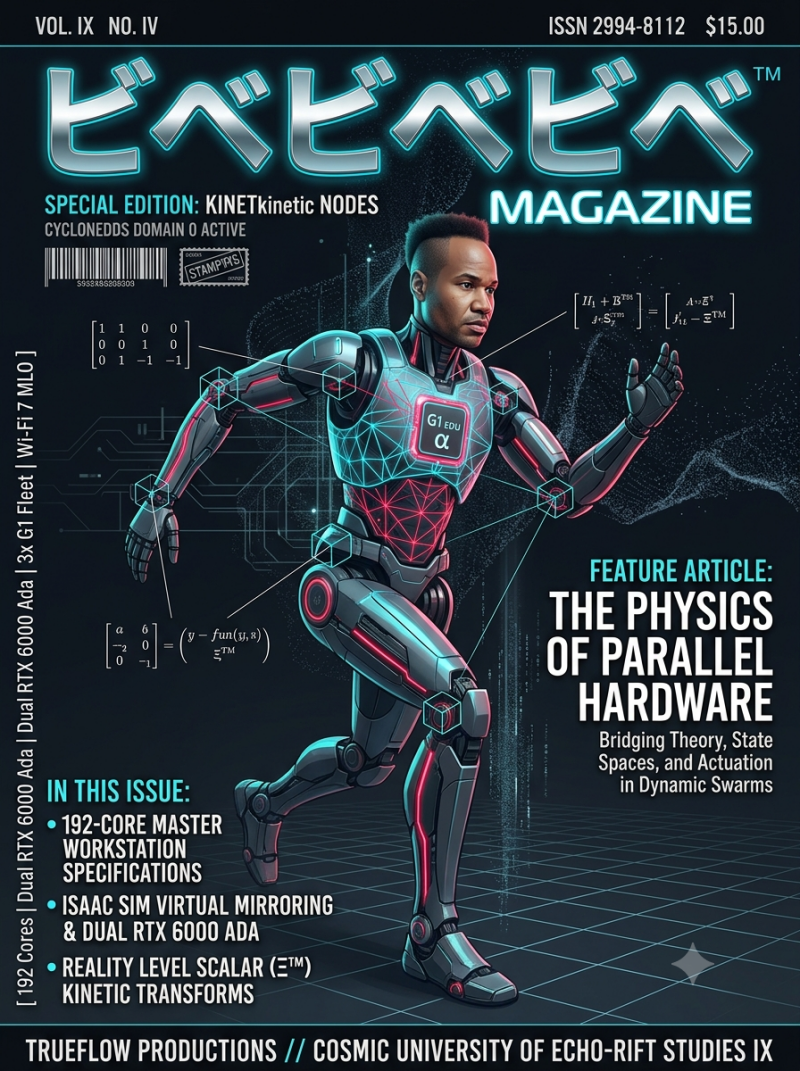
The Physics of Parallel Hardware: Bridging Theory and Actuation
For months, the mathematical scaffolding of Structured Multiversal Interactions (SMI) has existed in high-dimensional theory—mapped through polynomial functors, continuous topological state spaces, and the scalar dynamics of the Reality Level Scalar (Ξ™). But a theoretical framework, no matter how rigorous, eventually demands physical ground truth.
By orchestrating a distributed fleet of Unitree G1 EDU platforms linked via low-latency CycloneDDS over enterprise Wi-Fi 7, we unlock continuous parallel state-space sampling. Each physical node operates its onboard NVIDIA Jetson Orin module for localized kinematics, offloading global dynamic integrations to a master compute workstation.
CEO, TrueFlow Productions / ビべビべビべ™ Magazine
3× Bipedal Physical Nodes
Unitree G1 EDU platforms running local joint kinematics and low-latency state vector transforms over unitree_sdk2.
192-Core Central Compute
Dual AMD EPYC / Intel Xeon processor array dedicated to real-time differential trajectory solving and state transformations.
Dual RTX 6000 Ada Array
96GB total workstation VRAM driving concurrent NVIDIA Isaac Sim physical mirrors alongside CUDA matrix processing.
Spatial XR Interface
Real-time 6DoF teleoperation and spatial state rendering utilizing Apple Vision Pro / Meta Quest Pro over high-speed ROS2/DDS bridges.
Certified & Founded by
Dr. Melvin Sewell, M.Sc., Ph.D.
Academic Dean & Diagnostic Architect
Add comment
Comments