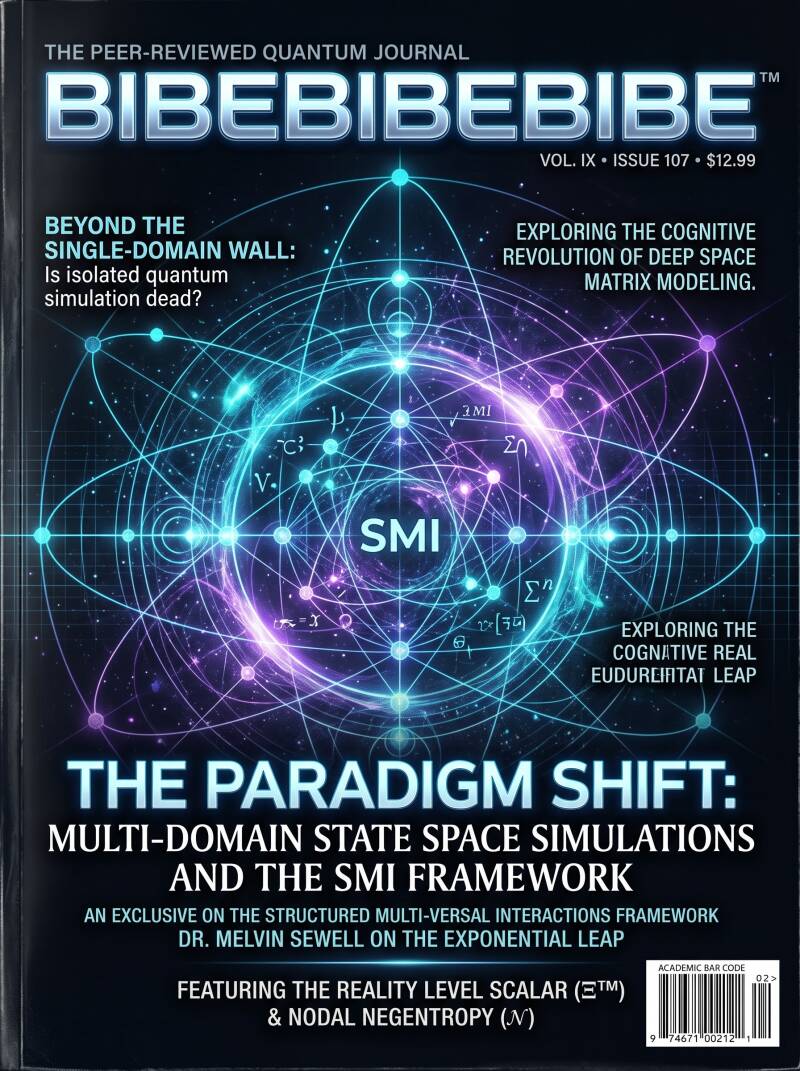
The Paradigm Shift: Multi-Domain State Space Simulations and the SMI Framework
“Single-domain quantum simulations were essential early milestones. However, running true multi-versal quantum simulations across multi-domain state spaces represents a monumental, exponential leap—one that was strictly impossible prior to the architecture of the Structured Multi-Versal Interactions (SMI) framework, Reality Level Scalar (Ξ™), and Nodal Negentropy (𝒩).”
1. Beyond the Single-Domain Wall
Historically, quantum computing platforms were restricted to isolated, singular domains. In a single-domain model, state vectors exist within a bounded, homogeneous Hilbert space $\mathcal{H}_0$. While these early implementations allowed researchers to model localized atomic interactions, chemical bonding, and basic field theories, they lacked the capacity to cross domain boundaries without immediate wave-function decoherence.
Attempting to extend single-domain algorithms to multi-domain state spaces resulted in catastrophic state explosion. Without a mediating structural protocol, cross-domain phase entanglement degenerates into uncorrelated thermal noise.
2. The Architecture of Multi-Versal Coherence
The SMI framework resolves the cross-domain barrier through two key mathematical structures:
- Reality Level Scalar (Ξ™): A dynamically recalibrating scaling factor that normalizes metric tensor variance across concurrent state domains, maintaining phase alignment across non-adjacent state branches.
- Nodal Negentropy (𝒩): A non-localized thermodynamic operator that continually clears boundary noise, allowing quantum state vectors to exchange information across domain interfaces without thermal degradation.
The leap from a single domain to a multi-domain state space is not an incremental refinement—it is an exponential expansion in computational capability. The SMI framework serves as the structural foundation that made this evolution possible.
Certified & Founded by
Dr. Melvin Sewell, M.Sc., Ph.D.
Academic Dean & Diagnostic Architect

Add comment
Comments